Velikovsky wasn't the first to suggest that Seti I actually reigned over 50 years. All three versions of Manetho's 19th dynasty begin with Seti and give him a reign of about 54 or 55 years. Same margin Herodotus gives Psammetichus.
Conventional chronology keeps shortening the reign of Seti I, apparently it recently became agreed upon that he didn't reign more then 11 years. Even though when discussing Ramses II's son Khaemweset on wikipedia Seti's year 14 is mentioned.
Viewing Psammetichus as Seti I allows us to identify Seti's reign having more then one potential start date. When he first started reigning as a local ruler upon the death of Rameses I/Necho I in 664 BC. When he became sole ruler of Egypt in his 9th year in 656 BC, same 9th year I suspect Rameses II was crowned as an infant. And possibly also later when he was recognized as independent by Assyria. In one source he seems to be bragging about a lot of accomplishments already in his first year.
Mainstream Egyptologists think Ramses II just made up the story about being crowned as an infant. Now I get the reasoning a King might do that, and that could still fit the revised chronology, just having him actually date later events from the made up coronation. But why randomly say it was Seti's 9th year? If according to conventional chronology Ramses was born before Seti's reign started, why not say Seti did this right at the start? That this lie was plausible is itself evidence Ramses birth didn't predate Seti's coronation. Now if Seti was Psametichus we have a reason his 9th year was important, but maybe that was also when Ramses was born, and so he claimed he was crowned at his birth.
Returning to the subject of Hophra/Apries/Merneptah, and Amasis. Herodotus reign lengths might be off here. I believe Apries took the throne in 589 BC. I think after 10 years was when he first fled Egypt. I think about 579-572 would be the seven year reign of Seti II who Herodotus was unaware of. Maybe Amenmes and Amasis are the same, maybe not. I think the native Egyptian 19th Dynasty records are unaware of Egypt's 40 year exile/captivity(Ezekiel 29-30), which is why most or maybe all of Amasis reign (44 years according to Herodotus) is unknown.
I'm thinking of moving the death of Apries from 567 BC to 573-570 BC. I think about 572-573 is also when Nebuchadnezzar conquered Egypt and sent them into captivity. Amasis specifically gets exiled to Cyprus which Egyptian 26th Dynasty history prefers to remember as him conquering Cyprus.
Cyrus allows Amasis and the Egyptians to return to Egypt not long after he allowed Judah to return. It's possible like with Judah many Egyptians didn't return and were scattered.
Psamtik III could perhaps be the same as Siptah. And Tworset the same as Nitetis, who I could see Cambyses allowing to reign as a vessel briefly after he defeated Psamtik III.
On the subject of the 19th Dynasty being perceived to directly follow the 18th. One historical mystery I want to talk about is how Manetho seems to kind of record the 19th Dynasty twice, once at the end of the 18th Dynasty, and a second time as the 19th Dynasty. Neither contains the whole picture of what archeology tells us. But both have someone with a name similar to Rameses Miamun reigning for 60some years, archeology knows of only one pharaoh who's reign total was in the 60s at all, much less with basically the same name.
I think the 19th Dynasty rulers themselves wanted to pretend they followed the 18th because the time in-between was largely foreign occupation. But maybe they did descend from some otherwise forgotten local dynasty that descended from the 18th? Or maybe Manetho's garbled history reflects efforts by some previous Egyptian scribe trying to fill a gap he knew existed but didn't know how to fill.
I already said I think the Seti who was Rameses I's father may have been the Sethos of Herodotus. With Rameses I as Necho I, perhaps this Seti is also either Nechepsos or Stephinates of Manetho's 26th dynasty before Necho I. Herodotus begins the dynasty with Necho I.
Maybe this Seti and his brother(s) can also be identified with the Sethosis and his brother(s) who end Manetho's 18th Dynasty. That places him about 710-700 BC. Then with him preceded by an Amenophis who reigned 40 years and a Miamun who reigned over 60, and then two short reigns for a Harmias and a Rameses, and then two Ascheneres of 12 years each. And you wind up with Rathotis very near where Velikovsky (and possibly myself) placed Tutankamun, who Rathotis is commonly identified with.
Going back to Seti II. He had a son named Seti-Merneptah about whom little is known. He's assumed to have died during Siptah's reign, but there is no proof of that.
Showing posts with label Ozymandias. Show all posts
Showing posts with label Ozymandias. Show all posts
Sunday, November 6, 2016

Thursday, October 27, 2016
The succesors of Rameses II aka Pharoh Necho
I already talked about Necho being Rameses. This is a follow up of sorts.
Revised Chronologists and Conventional Chronology both tend to assume the Pharaoh Jeremiah called Hophra is the same one Herodotus called Apries. Velikovsky identified that Pharaoh with Merneptah (hetep-her-maat) the son of Ramses II. One question not addressed usually is what about the Psamtik II who came between Necho and Apries according to Herodotus?
Well first I think Herodotus was likely mistaken on how they're genealogically related.
Psamtik II invaded Nubia. I think that war with Nubia should perhaps be identified with Rameses II's Nubian Campaign in his 22nd year.
Interestingly in Abu Simbel a Greek Graiftti on a statue of Ramses II reads.
We know Rameses was accompanied on that campaign by Amun-her-khepeshef his original Crown Prince. When discussing the Sed Festival of Rameses year 30 it is said that Amun-her-khepeshef became effectively co-ruler. But that seems like a contradiction since Amum is supposed to have died in year 26. But given Velikovsky's suggestions on how to count the reign of Rameses, this could be a difference of which year 30.
Amun had one known son, a son named Seti. Psamtik's only alleged son is Apries but is said to have had daughters, one was a High Priestess of Heliopolis which could be interesting latter.
Timeline wise that would then put Amum's death about 589 BC, a date commonly given for the death of Psammetichos II. And Ussher's date for a military victory Nebuchadnezzar had over Egypt leading up to the fall of Jerusalem (Jeremiah 37), an event dated partly on the grounds of Ezekiel 30:20-21.
Ezekiel 30 seems to refer to a Pharaoh of Egypt being mortally wounded by the Sword of the King of Babylon (inferred to be Nebuchadnezzar). Generally it is debated whether this means Necho or Hophra, but the Mummy of Amun-her-khepeshef has a mortal head wound, usually theorized to be from a Mace but I think it could have been a Sword. (But The Bible sometimes uses "Sword" idiomatically of any weapon or act of violence.) Those who think Rameses was the Pharaoh of the Exodus attempt to use this as evidence Amun was the first born killed in the 10th Plague, but I think this Biblical connection is far more compelling.
On page 201 of Ages in Chaos II Ramses II and his time, Velikovsky mentions the head of Merneptah's mummy having a hole made by a sharp instrument in it, and suggests he died violently. However nothing else I've read seems to back up this claim, and the images I've seen of Merneptah's Mummy shows no damage besides something that looks probably post-mortem. Still Velikovsky argued this not even citing Ezekiel's statement.
One issue Velikovsky didn't address when dealing with the reign length of Rameses is that there were two Crown Princes who each served 25 years who predeceased him. First Amum from year 1 to 26, then another Rameses from years 25-50. I however have no trouble seeing them serving as Crown Prince at the same time, perhaps Ramses considered dividing upper and lower Egypt again. Also each was the firstborn of a different wife. Perhaps for whatever weird reason Amun was usually dated from Rameses II sole rule, while Prince Ramses was dated from the co-regency with Seti.
In Against Apion 1:26 Josephus addresses a story that seems to serve as an alleged Egyptian POV of the Exodus. This story is the source of affiliating the 19th and/or 18th Dynasty with the Exodus due to it being seemingly affiliated with the same Amenophis identified as the successor of Rameses Miamun who reigned 66 years. I've always been intrigued by this story since it's obviously mythical propaganda and I place the Exodus in the 12th or 13th Dynasty, yet still I've always suspected there is an otherwise forgotten real chapter of 19th Dynasty history hidden here.
Osarsiph who is alleged to be Moses is identified as a Priest of Heliopolis/On. What's curious about that is that one of the sons of Rameses II was High Priest of On, Meryatum. He was the son of Nefertari, the same mother as Amun-her-khepeshef, but a different one then Merneptah, so who knows what kinds of sibling rivalries they might have had.
The story involved him conspiring with descendants of the centuries before expelled Hyksos, or at least people coming from the same area. Velikovsky tied the Hyksos to the Amalekites, but 1 Chronicles 4:40-43 records the last of the Amalekites being wiped out by the Simeonites when they migrated to Edom in the time of Hezekiah. And earlier the city of Sharuhen was allotted to Simeon in the Book of Joshua, the actual city the Hyksos fled to when Avaris fell. Maybe Simeonites were involved in this and that is where the Hyksos and Israelites being confused with each other begins?
Because of Jeremiah 43 and 44 we know many Israelites came to Egypt during the reign of Hophra.
I have discussed the Sea Peoples before mainly in the context of Rameses III and the 20th Dynasty. But Merneptah also encountered them (and Ramses II had a battle with just the Sherden). This comes up in Ages of Chaos II connecting this to Apries wars involving Cyrene. Perhaps that also ties into the above story.
As for why Merneptah seems to be called Amenophis in Manetho as transcribed by Josephus in Against Apion. This story also mentions this Pharaoh Amenophis seeking advise from someone else who has the same name. Maybe the retelling of this story gave the name of this adviser to the Pharaoh himself for some reason. Among the Children of Rameses there is an Amenhotep listed as number 14, right after Merneptah. The Amenhoteps of the 18th dynasty tended to become Amenophis in Manetho as transcribed by Josephus. And there was also an Amunemopet (“Amun on the Opet Feast”). Perhaps one of his brothers became this key adviser of Merneptah? Neither is a son of Nefertari meaning they could be of the same mother as Merneptah.
Another note on the Children of Rameses, one being named Astarteherwenemef (“Astarte Is with His Right Arm”) I also feel circumstantially better fits his reign being during the Neo-Babylonian era. His daughter Bintanath also has a Semitic name.
I think it's possible that Herodotus history of Amasis is very wrong, and that he was influenced by native Egyptian propaganda seeking to hide that Amasis was really a puppet of Nebuchadnezzar. Basically in the account of the civil war between Apries and Amasis, I think which side had Babylon's backing got switched. And this switching of the history to say Babylon backed the losing side is why skeptics think The Bible is wrong in saying Nebuchadnezzar conquered Egypt. Bishop Ussher expressed a similar view on the matter.
It is popular in Revised Chronology to suggest the post Merneptah 19th Dynasty Pharaohs actually reigned before Ramses I. I'm not as convinced of that argument. The Sethos of Herodotus being the Seti who was Rameses I's father is plausible however.
Amasis does not seem to be recorded in the traditional 19th Dynasty sources, at least not as a Phararoh. I'd in the past considered identifying him with Amenmesse, but his reign was too short.
I'm now considering that Amasis could be the same as Meryatum/Osarsiph, or some other half-brother of Merneptah. The name Amasis (used in Greek texts to transliterate Ahmose) has in it the Egyptian root that the name of Moses (Moshe) comes from, so perhaps that is a factor in this person being identified with Moses much later. Amasis was earlier a leading general of Psamtik II's conquest of Nubia, perhaps that's a factor in how the extra-Biblical legend of Moses conquering Ethiopia came about.
Seti II and Amenmesse tend to be identified in Manetho as transcribed by Josephus with Sethosis and Rameses also called Armais/Hermeus. The "two brothers" they are often called. But based on the direct 19th Dynasty sources the paternity of Amenmesse is uncertain, though his mother seems to be a Takhat, who was also the mother of Seti II's wife Twosret, and yet also listed as his wife herself. And a Takhat is also one of the named daughters of Rameses II. So maybe the story as known to Manetho is off on the exact genealogy.
Some of the lesser sons of Rameses II listed separate from the main 28 I think could maybe actually be Grandsons. Either way many of them were named Rameses, so perhaps that could help explain Amenmesse also being known as Rameses. Or what if the source naming a daughter of Rameses II as Takhat is actually using that as an alternate name for one of the more well known daughters that Rameses married himself? Yes he married at least three of his own daughters.
I've seen it claimed these later 19th dynasty rulers only really ruled Upper Egypt, that could explain them being unknown to Herodotus and other Greek historians.
The misconception that the 19th Dynasty followed the 18th directly may well go back to official propaganda of the 19th dynasty. The history we place in-between is pretty much defined by foreign occupation, Libyan(22nd and 23rd) Nubian(25th) and Assyria.
I should also mention the theory of Osarseph being Chancellor Bey. Bey is now known to have been executed during the reign of Siptah. That theory is partly dependent on assuming Bey is the same as Irsu of the Papyrus Harris, which under Revised Chronology seems a lot less likely. I forget whether or not Velikvosky identified Irsu with anyone.
Revised Chronologists and Conventional Chronology both tend to assume the Pharaoh Jeremiah called Hophra is the same one Herodotus called Apries. Velikovsky identified that Pharaoh with Merneptah (hetep-her-maat) the son of Ramses II. One question not addressed usually is what about the Psamtik II who came between Necho and Apries according to Herodotus?
Well first I think Herodotus was likely mistaken on how they're genealogically related.
Psamtik II invaded Nubia. I think that war with Nubia should perhaps be identified with Rameses II's Nubian Campaign in his 22nd year.
Interestingly in Abu Simbel a Greek Graiftti on a statue of Ramses II reads.
"When King Psammetichus (i.e., Psamtik II) came to Elephantine, this was written by those who sailed with Psammetichus the son of Theocles, and they came beyond Kerkis as far as the river permits. Those who spoke foreign tongues (Greek and Carians who also scratched their names on the monument) were led by Potasimto, the Egyptians by Amasis. ["king Psammetichus II (Psamtik II)". Touregypt.net. Retrieved 2011-11-20.]Which I think is good circumstantial evidence.
We know Rameses was accompanied on that campaign by Amun-her-khepeshef his original Crown Prince. When discussing the Sed Festival of Rameses year 30 it is said that Amun-her-khepeshef became effectively co-ruler. But that seems like a contradiction since Amum is supposed to have died in year 26. But given Velikovsky's suggestions on how to count the reign of Rameses, this could be a difference of which year 30.
Amun had one known son, a son named Seti. Psamtik's only alleged son is Apries but is said to have had daughters, one was a High Priestess of Heliopolis which could be interesting latter.
Timeline wise that would then put Amum's death about 589 BC, a date commonly given for the death of Psammetichos II. And Ussher's date for a military victory Nebuchadnezzar had over Egypt leading up to the fall of Jerusalem (Jeremiah 37), an event dated partly on the grounds of Ezekiel 30:20-21.
Ezekiel 30 seems to refer to a Pharaoh of Egypt being mortally wounded by the Sword of the King of Babylon (inferred to be Nebuchadnezzar). Generally it is debated whether this means Necho or Hophra, but the Mummy of Amun-her-khepeshef has a mortal head wound, usually theorized to be from a Mace but I think it could have been a Sword. (But The Bible sometimes uses "Sword" idiomatically of any weapon or act of violence.) Those who think Rameses was the Pharaoh of the Exodus attempt to use this as evidence Amun was the first born killed in the 10th Plague, but I think this Biblical connection is far more compelling.
On page 201 of Ages in Chaos II Ramses II and his time, Velikovsky mentions the head of Merneptah's mummy having a hole made by a sharp instrument in it, and suggests he died violently. However nothing else I've read seems to back up this claim, and the images I've seen of Merneptah's Mummy shows no damage besides something that looks probably post-mortem. Still Velikovsky argued this not even citing Ezekiel's statement.
One issue Velikovsky didn't address when dealing with the reign length of Rameses is that there were two Crown Princes who each served 25 years who predeceased him. First Amum from year 1 to 26, then another Rameses from years 25-50. I however have no trouble seeing them serving as Crown Prince at the same time, perhaps Ramses considered dividing upper and lower Egypt again. Also each was the firstborn of a different wife. Perhaps for whatever weird reason Amun was usually dated from Rameses II sole rule, while Prince Ramses was dated from the co-regency with Seti.
In Against Apion 1:26 Josephus addresses a story that seems to serve as an alleged Egyptian POV of the Exodus. This story is the source of affiliating the 19th and/or 18th Dynasty with the Exodus due to it being seemingly affiliated with the same Amenophis identified as the successor of Rameses Miamun who reigned 66 years. I've always been intrigued by this story since it's obviously mythical propaganda and I place the Exodus in the 12th or 13th Dynasty, yet still I've always suspected there is an otherwise forgotten real chapter of 19th Dynasty history hidden here.
Osarsiph who is alleged to be Moses is identified as a Priest of Heliopolis/On. What's curious about that is that one of the sons of Rameses II was High Priest of On, Meryatum. He was the son of Nefertari, the same mother as Amun-her-khepeshef, but a different one then Merneptah, so who knows what kinds of sibling rivalries they might have had.
The story involved him conspiring with descendants of the centuries before expelled Hyksos, or at least people coming from the same area. Velikovsky tied the Hyksos to the Amalekites, but 1 Chronicles 4:40-43 records the last of the Amalekites being wiped out by the Simeonites when they migrated to Edom in the time of Hezekiah. And earlier the city of Sharuhen was allotted to Simeon in the Book of Joshua, the actual city the Hyksos fled to when Avaris fell. Maybe Simeonites were involved in this and that is where the Hyksos and Israelites being confused with each other begins?
Because of Jeremiah 43 and 44 we know many Israelites came to Egypt during the reign of Hophra.
I have discussed the Sea Peoples before mainly in the context of Rameses III and the 20th Dynasty. But Merneptah also encountered them (and Ramses II had a battle with just the Sherden). This comes up in Ages of Chaos II connecting this to Apries wars involving Cyrene. Perhaps that also ties into the above story.
As for why Merneptah seems to be called Amenophis in Manetho as transcribed by Josephus in Against Apion. This story also mentions this Pharaoh Amenophis seeking advise from someone else who has the same name. Maybe the retelling of this story gave the name of this adviser to the Pharaoh himself for some reason. Among the Children of Rameses there is an Amenhotep listed as number 14, right after Merneptah. The Amenhoteps of the 18th dynasty tended to become Amenophis in Manetho as transcribed by Josephus. And there was also an Amunemopet (“Amun on the Opet Feast”). Perhaps one of his brothers became this key adviser of Merneptah? Neither is a son of Nefertari meaning they could be of the same mother as Merneptah.
Another note on the Children of Rameses, one being named Astarteherwenemef (“Astarte Is with His Right Arm”) I also feel circumstantially better fits his reign being during the Neo-Babylonian era. His daughter Bintanath also has a Semitic name.
I think it's possible that Herodotus history of Amasis is very wrong, and that he was influenced by native Egyptian propaganda seeking to hide that Amasis was really a puppet of Nebuchadnezzar. Basically in the account of the civil war between Apries and Amasis, I think which side had Babylon's backing got switched. And this switching of the history to say Babylon backed the losing side is why skeptics think The Bible is wrong in saying Nebuchadnezzar conquered Egypt. Bishop Ussher expressed a similar view on the matter.
It is popular in Revised Chronology to suggest the post Merneptah 19th Dynasty Pharaohs actually reigned before Ramses I. I'm not as convinced of that argument. The Sethos of Herodotus being the Seti who was Rameses I's father is plausible however.
Amasis does not seem to be recorded in the traditional 19th Dynasty sources, at least not as a Phararoh. I'd in the past considered identifying him with Amenmesse, but his reign was too short.
I'm now considering that Amasis could be the same as Meryatum/Osarsiph, or some other half-brother of Merneptah. The name Amasis (used in Greek texts to transliterate Ahmose) has in it the Egyptian root that the name of Moses (Moshe) comes from, so perhaps that is a factor in this person being identified with Moses much later. Amasis was earlier a leading general of Psamtik II's conquest of Nubia, perhaps that's a factor in how the extra-Biblical legend of Moses conquering Ethiopia came about.
Seti II and Amenmesse tend to be identified in Manetho as transcribed by Josephus with Sethosis and Rameses also called Armais/Hermeus. The "two brothers" they are often called. But based on the direct 19th Dynasty sources the paternity of Amenmesse is uncertain, though his mother seems to be a Takhat, who was also the mother of Seti II's wife Twosret, and yet also listed as his wife herself. And a Takhat is also one of the named daughters of Rameses II. So maybe the story as known to Manetho is off on the exact genealogy.
Some of the lesser sons of Rameses II listed separate from the main 28 I think could maybe actually be Grandsons. Either way many of them were named Rameses, so perhaps that could help explain Amenmesse also being known as Rameses. Or what if the source naming a daughter of Rameses II as Takhat is actually using that as an alternate name for one of the more well known daughters that Rameses married himself? Yes he married at least three of his own daughters.
I've seen it claimed these later 19th dynasty rulers only really ruled Upper Egypt, that could explain them being unknown to Herodotus and other Greek historians.
The misconception that the 19th Dynasty followed the 18th directly may well go back to official propaganda of the 19th dynasty. The history we place in-between is pretty much defined by foreign occupation, Libyan(22nd and 23rd) Nubian(25th) and Assyria.
I should also mention the theory of Osarseph being Chancellor Bey. Bey is now known to have been executed during the reign of Siptah. That theory is partly dependent on assuming Bey is the same as Irsu of the Papyrus Harris, which under Revised Chronology seems a lot less likely. I forget whether or not Velikvosky identified Irsu with anyone.
Friday, March 21, 2014
Rameses II as Pharaoh Necho
"A fragment of a mural from a Theban temple of Ramses II, preserved in the Metropolitan Museum of New York, shows a Palestinian prince, mortally wounded by a dart or a lance thrown by one of the Egyptian Warriors, an the army of this prince is in great dismay."-H.E. Winlock: Excavations at Deir el Bahari, 1911-1913 (New York 1942), p. 12 and plate 6g.Above are footnotes from Ages in Chaos II about the first Syrian campaign of Ramses II.
"An obelisk of Rameses II at Tanis mentions "Carrying off the princes of Retenu (Palestine) as living prisoners" The word "princes" is written on the obelisk with a heiroglyph of a size disproportionate to the rest of the inscription, emphasizing their royal status."-See Kemi, revue de philologie et d'archeologie egytpiennes et coptes, V(1935). Plate 26. and p. 113
http://en.wikipedia.org/wiki/Ramesses_II#First_Syrian_campaign
The immediate antecedents to the Battle of Kadesh were the early campaigns of Ramesses II into Canaan and Palestine. His first campaign seems to have taken place in the fourth year of his reign and was commemorated by the erection of a stele near modern Beirut. The inscription is almost totally illegible due to weathering. His records tell us that he was forced to fight a Palestinian prince who was mortally wounded by an Egyptian archer, and whose army was subsequently routed. Ramesses carried off the princes of Palestine as live prisoners to Egypt. Ramesses then plundered the chiefs of the Asiatics in their own lands, returning every year to his headquarters at Riblah to exact tribute.
Now compare that to what Necho does.
II Kings 23: 29-35.
In his days Pharaohnechoh king of Egypt went up against the king of Assyria to the river Euphrates: and king Josiah went against him; and he slew him at Megiddo, when he had seen him. And his servants carried him in a chariot dead from Megiddo, and brought him to Jerusalem, and buried him in his own sepulchre. And the people of the land took Jehoahaz the son of Josiah, and anointed him, and made him king in his father's stead.-----And Pharaohnechoh put him in bands at Riblah in the land of Hamath, that he might not reign in Jerusalem; and put the land to a tribute of an hundred talents of silver, and a talent of gold. And Pharaohnechoh made Eliakim the son of Josiah king in the room of Josiah his father, and turned his name to Jehoiakim, and took Jehoahaz away: and he came to Egypt, and died there. And Jehoiakim gave the silver and the gold to Pharaoh; but he taxed the land to give the money according to the commandment of Pharaoh: he exacted the silver and the gold of the people of the land, of every one according to his taxation, to give it unto Pharaohnechoh.
II Chronciles 35:20-35:4.
After all this, when Josiah had prepared the temple, Necho king of Egypt came up to fight against Carchemish by Euphrates: and Josiah went out against him. But he sent ambassadors to him, saying, What have I to do with thee, thou king of Judah? I come not against thee this day, but against the house wherewith I have war: for God commanded me to make haste: forbear thee from meddling with God, who is with me, that he destroy thee not. Nevertheless Josiah would not turn his face from him, but disguised himself, that he might fight with him, and hearkened not unto the words of Necho from the mouth of God, and came to fight in the valley of Megiddo. And the archers shot at king Josiah; and the king said to his servants, Have me away; for I am sore wounded. His servants therefore took him out of that chariot, and put him in the second chariot that he had; and they brought him to Jerusalem, and he died, and was buried in one of the sepulchres of his fathers. And all Judah and Jerusalem mourned for Josiah. And Jeremiah lamented for Josiah: and all the singing men and the singing women spake of Josiah in their lamentations to this day, and made them an ordinance in Israel: and, behold, they are written in the lamentations.-----Then the people of the land took Jehoahaz the son of Josiah, and made him king in his father's stead in Jerusalem.----And the king of Egypt put him down at Jerusalem, and condemned the land in an hundred talents of silver and a talent of gold. And the king of Egypt made Eliakim his brother king over Judah and Jerusalem, and turned his name to Jehoiakim. And Necho took Jehoahaz his brother, and carried him to Egypt.
The
same number of years that separate this event from Carchemish,
separated Ramses II's first Syrian Campaign from his second. Which was
his battle of "Kadesh". Herdotus when referring to seemingly the same campaign of Necho mentions not Carchemish but a city called Cadytis which sounds like a Greek transliteration of Kadesh.
Herodotus (Book II: 158) says Necho II initiated but never completed the ambitious project of cutting a navigable canal from the Pelusiac branch of the Nile to the Red Sea. Necho's Canal was the earliest precursor of the Suez Canal. Archaeology says Ramses II did that, and there is no evidence of any Suez Canal construction by any 26th Dynasty Pharaohs.
Supporters of the conventional chronology care a great deal about names. So Necho not being identical to Ramses is a big deal to them. But the Bible often refers to foreign leaders by code names or nicknames, sometimes being puns on a real name of theirs but maybe not always.
Necho's Strongs Number is 5224 (Pharohnecho is 6549 near Pharaoh). Necho is similar to the Hebrew words Nekeh (5222 abject) or Nakeh (5223, Contrite, Lame), and also Nachon (5225) the name of an Israelite mentioned in 2 Samuel 6:6.
The Talmud implies somewhere Nehco was a Hebrew nickname for that King meaning "The Lame One". A source for this I now have, Page 93 of Disability and Isaiah's suffering Servant by Jeremy Shchiper.
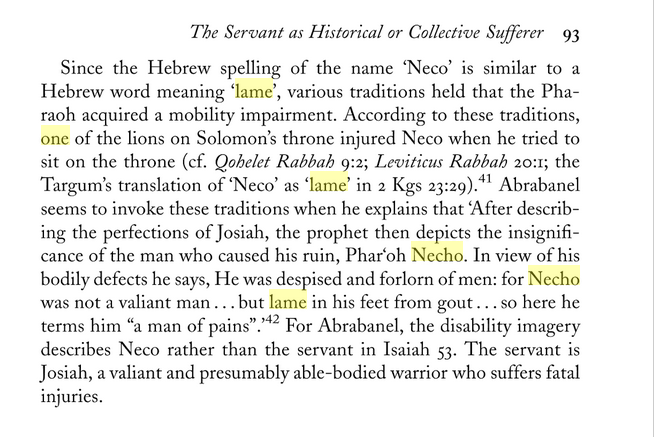 The name is believed to reflect him having some sort of disability, perhaps one effecting his ability to walk. From Wikipedia about Ramses II's Mummy.
But if I wanted to look for Necho among Ramses known Egyptian names. Pharaohs, especially Ramses, had many names, usually at least 5, but Ramses is known to have had many more.
Names Ramses II is known to have had
Hor “Falcon King”: Ka-nakht "Strong Bull”, Mery-Ma’at “Beloved of Truth"
Nebty “He of the Two Goddesses”:, Mek-Kemet "Protector of Egypt,” Waf-khasut “Who curbs foreign lands",
Hor-nub “Horus of Gold”: User-renput "Rich in Years,” Aa-nehktu “Great in Victories",
Nesu-bity (Insibya) “King of Upper & Lower Egypt”: User-maat-Re ("Strong in Right is Re") [Setep-en-Re "Chosen of Re"]
Se Re “Son of Re”: Rameses Mery-Amun “Beloved of Amun” [Nutjer-Heqa-Iunu "God, Ruler of Heliopolis"]
Leaving out Translations you get.
Hor: Ka-nakht Mery-Ma’at;
Nebty: Mek-Kemet Waf-khasut;
Hor-nub: User-renput Aa-nehktu;
Nesu-bity (Insibya): USER-MAAT-RE Setep-en-Re;
Se Re: RAMESES Mery-Amun Nutjer Heqa-Iunu.
Either nakht or nehktu could be the basis for Necho, especially if corrupted for the sake of a Hebraic pun. This Egyptian epithet meant Mighty.
Supporters of conventional chronology love to insist that generally only the Insybya (USER-MAAT-RE Setep-en-Re for Ramses II) and Nomen (RAMESES Mery-Amun Nutjer Heqa-Iunu. for Ramses II) were ones the Pharaoh was generally refereed to by, especially by foreigners. But given our lack of total information that's frankly an assumption. Maybe scholars have decided that simply because those two names are often the ones that seem to fit conventional chronology.
They've also claimed my two potential Necho sources here are names all or most Pharaohs of the period had so it'd be useless in identifying which Pharaoh. Thing is I don't believe identification was the intent in the Biblical accounts at all, I believe both Biblical accounts were written soon after the events happened, their original readers would have known who without issue. Notice how Pharaoh and Necho are often put together as if they're one word Pharaohnecho.
In fact it's primarily because of The Bible modern society is so used to calling the rulers of Egypt Pharaoh. That wasn't really a thing in ancient Egypt, the word Pharaoh comes from a title of the King's Royal Palace. So it really was similar to referring to a United States Presidential administration as The White House.
Herodotus (Book II: 158) says Necho II initiated but never completed the ambitious project of cutting a navigable canal from the Pelusiac branch of the Nile to the Red Sea. Necho's Canal was the earliest precursor of the Suez Canal. Archaeology says Ramses II did that, and there is no evidence of any Suez Canal construction by any 26th Dynasty Pharaohs.
Supporters of the conventional chronology care a great deal about names. So Necho not being identical to Ramses is a big deal to them. But the Bible often refers to foreign leaders by code names or nicknames, sometimes being puns on a real name of theirs but maybe not always.
Necho's Strongs Number is 5224 (Pharohnecho is 6549 near Pharaoh). Necho is similar to the Hebrew words Nekeh (5222 abject) or Nakeh (5223, Contrite, Lame), and also Nachon (5225) the name of an Israelite mentioned in 2 Samuel 6:6.
The Talmud implies somewhere Nehco was a Hebrew nickname for that King meaning "The Lame One". A source for this I now have, Page 93 of Disability and Isaiah's suffering Servant by Jeremy Shchiper.
As far as Herodotus knowing him by the same name, he often got names wrong, and he was accused by Manetho and others of outright lying. Either directly or indirectly he could have heard the name from a Jewish source, or another Semitic one. And then heard he was named after his grandfather and just assumed that was the same name he knew him by.In Paris, fungus was found attacking Ramesses's mummy and killed. During the examination, scientific analysis revealed battle wounds, old fractures, arthritis and poor circulation.Ramesses II's arthritis is believed to have made him walk with a hunched back for the last decades of his life.[Bob Brier, The Encyclopedia of Mummies, Checkmark Books, 1998, p. 153.] A recent study excludedankylosing spondylitis as a possible cause.[Can. Assoc. Radiol. J. 2004 Oct;55(4):211–7, PMID 15362343.]
But if I wanted to look for Necho among Ramses known Egyptian names. Pharaohs, especially Ramses, had many names, usually at least 5, but Ramses is known to have had many more.
Names Ramses II is known to have had
Hor “Falcon King”: Ka-nakht "Strong Bull”, Mery-Ma’at “Beloved of Truth"
Nebty “He of the Two Goddesses”:, Mek-Kemet "Protector of Egypt,” Waf-khasut “Who curbs foreign lands",
Hor-nub “Horus of Gold”: User-renput "Rich in Years,” Aa-nehktu “Great in Victories",
Nesu-bity (Insibya) “King of Upper & Lower Egypt”: User-maat-Re ("Strong in Right is Re") [Setep-en-Re "Chosen of Re"]
Se Re “Son of Re”: Rameses Mery-Amun “Beloved of Amun” [Nutjer-Heqa-Iunu "God, Ruler of Heliopolis"]
Leaving out Translations you get.
Hor: Ka-nakht Mery-Ma’at;
Nebty: Mek-Kemet Waf-khasut;
Hor-nub: User-renput Aa-nehktu;
Nesu-bity (Insibya): USER-MAAT-RE Setep-en-Re;
Se Re: RAMESES Mery-Amun Nutjer Heqa-Iunu.
Either nakht or nehktu could be the basis for Necho, especially if corrupted for the sake of a Hebraic pun. This Egyptian epithet meant Mighty.
Supporters of conventional chronology love to insist that generally only the Insybya (USER-MAAT-RE Setep-en-Re for Ramses II) and Nomen (RAMESES Mery-Amun Nutjer Heqa-Iunu. for Ramses II) were ones the Pharaoh was generally refereed to by, especially by foreigners. But given our lack of total information that's frankly an assumption. Maybe scholars have decided that simply because those two names are often the ones that seem to fit conventional chronology.
They've also claimed my two potential Necho sources here are names all or most Pharaohs of the period had so it'd be useless in identifying which Pharaoh. Thing is I don't believe identification was the intent in the Biblical accounts at all, I believe both Biblical accounts were written soon after the events happened, their original readers would have known who without issue. Notice how Pharaoh and Necho are often put together as if they're one word Pharaohnecho.
In fact it's primarily because of The Bible modern society is so used to calling the rulers of Egypt Pharaoh. That wasn't really a thing in ancient Egypt, the word Pharaoh comes from a title of the King's Royal Palace. So it really was similar to referring to a United States Presidential administration as The White House.
Subscribe to:
Posts (Atom)